
The Office, Reinvented.
Eight forces reshaping how we furnish, experience, and inhabit the workplace - from modular systems and smart desks to sensory sanctuaries and the art of the in-between.
Contents
- The Office, Reinvented.
- Trend 01 - Modular Furniture & Adaptive Layouts
- Trend 02 - Advanced Ergonomics & Micro-Movement Design
- Trend 03 - Circular Sustainability & Artisan Materials
- Trend 04 - Technology-Integrated Furniture
- Trend 05 - Acoustic Architecture & Sensory Zoning
- Trend 06 - Biophilic & Resimercial Design
- Trend 07 - Third Spaces & the Social Office
- Trend 08 - Smart Storage & the Nomad Kit
- Eight Trends. One Direction.
J Sanderson
The Office, Reinvented.
The office is no longer a place you go because you must. In 2026, it has to earn its commute – and furniture is doing most of the persuading.
After years of hybrid experimentation, 2026 marks a genuine turning point. Commercial furniture has become a strategic investment – a signal of culture, values, and ambition rather than a procurement line item to be minimised at the end of the design process.
The spaces that thrive this year are those designed around how people actually think, move, collaborate, and rest. These are the eight trends making it happen.
Trend 01 - Modular Furniture & Adaptive Layouts
The era of the fixed floor plan is over. Offices in 2026 are built around the principle that no configuration should outlast its usefulness. Modular furniture – desks, dividers, storage — is designed to be rearranged in hours without tools, contractors, or costly downtime.
This shift is economic as much as it is aesthetic. Businesses no longer want to invest in a layout that locks them in for five years. Modular systems and moveable walls now support activity-based working – diverse settings for focus, collaboration, learning, and socialising — all without a single structural intervention.
The hexagonal desk has become a symbol of this era: clustering easily for team sessions, separating cleanly for heads-down work, and looking nothing like the soul-crushing grid of the past. But modularity is bigger than any single piece – it’s a philosophy now underpinning how entire floors are conceived and specced.
“Offices that can’t flex with the team will simply be left behind.”
- Rearrangeable stations – keep workspaces fresh without construction costs
- Mix-and-match components – handle hybrid headcount fluctuation naturally
- Moveable walls – allow zones to be created and dissolved in real time
- Non-rectangular forms – hexagonal, organic – are replacing the desk grid
Trend 02 - Advanced Ergonomics & Micro-Movement Design
Your Furniture Should Move With You
Ergonomic furniture has graduated from premium perk to baseline expectation. Sit-stand desks are now standard specification. Lumbar-support seating is table stakes. The frontier in 2026 is what comes next: furniture calibrated to micro-movements – recline resistance tuned to spine angle, armrests shaped to eliminate shoulder fatigue over hours.
Smart sensors embedded in chairs now alert users when posture has drifted or when a rest is overdue. Ventilation, lighting, and workstation layout are no longer treated as separate disciplines – they’re designed as a single interdependent system that supports cognitive function across a full working day.
Height-adjustable surfaces are expanding beyond the individual desk to meeting tables, collaboration zones, and coffee stations – extending the sit-stand principle across the entire floor plan rather than isolating it to individual workstations.
Trend 03 - Circular Sustainability & Artisan Materials
Sustainability in 2026 has moved decisively beyond certifications and green labels. The conversation is now about circularity, traceability, and materials that tell a story. Procurement teams want to know where the wood was milled, who finished the upholstery, and how the piece will be reclaimed when its office life ends.
Take-back programmes, longer warranties, and furniture designed for repair rather than replacement are becoming commercial requirements rather than nice-to-haves. The throwaway fit-out is being refused by forward-thinking businesses – environmentally unacceptable and commercially short-sighted in equal measure.
Upholstery is shifting from foam-backed composites to structured wool, jute, and full-grain leather – materials that age gracefully. Veneers are selected from matched sets. Joinery is exposed rather than hidden. Visible grain is no longer a manufacturing flaw; it’s evidence of origin and craft.
“Visible grain is no longer a flaw – it’s proof of origin, process, and intentionality.”
- Take-back programmes – are becoming a condition of procurement
- Recycled and upcycled materials – now meet premium durability standards
- Local suppliers – reduce carbon and strengthen regional craft
- Wool, jute, leather – replacing foam composites in quality upholstery
Trend 04 - Technology-Integrated Furniture
Built In, Not Bolted On
The office of 2026 is seamlessly connected in ways that were aspirational just a few years ago. Wireless charging pads, USB-C hubs, and Bluetooth connectivity are integrated from the design stage – not as afterthought accessories bolted beneath a desk, but as load-bearing features of the furniture brief.
Cable clutter is becoming commercially unacceptable. Hidden cable paths keep surfaces pristine. Desks double as charging stations. Smart desks track usage, adjust height automatically based on stored user preferences, and interface with building management systems to control lighting and climate per individual workstation.
AI-powered workplace analytics are now informing how floors are laid out – revealing how people actually move through a space and enabling fit-outs that evolve over time rather than stagnate after day one.
Trend 05 - Acoustic Architecture & Sensory Zoning
Silence Is the New Luxury
Open-plan offices are not going away. But the industry is finally getting serious about their greatest flaw: noise. Acoustic pods, high-backed seating, felt-wrapped partitions, and sound-absorbing panels are being designed as primary architectural elements of the floor plan – not afterthoughts.
The self-contained acoustic pod has become the defining furniture form of this era: a beautifully finished sanctuary for focused calls or deep work. For companies competing to justify the commute, offering quieter concentration than the home office is a genuinely compelling argument.
- 01 – Acoustic Pods – Self-contained booths for focused calls and deep work, finished to hospitality standard.
- 02 – High-Back Seating – Chairs and sofas that create natural sound barriers without closing the space
- 03 – Felt Partitions – Sound-absorbing dividers that zone space visually and acoustically at once
- 04 – Fabric Surfaces – Upholstered walls and soft materials reducing echo across open environments
Trend 06 - Biophilic & Resimercial Design
Resimercial – the blending of residential warmth with commercial durability – has moved from trend to settled direction. The cold, impersonal office of the previous decade is gone. What replaces it feels considered, warm, and genuinely liveable in a way the stripped-back minimalism of the 2010s never managed.
Upholstered seating replaces cold plastics. Wood finishes, rugs, and layered lighting create spaces that feel personal rather than institutional. The visual language is deliberately warm: muted neutrals and sophisticated tones over loud brand colour, with accents woven through textiles and furniture.
Biophilic design sits at the heart of this shift. Living walls, indoor planting, maximised natural light, and organic material patterns are now standard expectations — backed by a robust body of evidence that connection to nature improves focus, creativity, and long-term wellbeing.
- Living walls and indoor planting – are now baseline, not premium additions
- Warm neutrals and natural tones – replace saturated brand colour
- Rugs, layered lighting, texture – create domestic comfort at commercial scale
- Neurodiversity – informs sensory zoning – calm and stimulating spaces coexist
Trend 07 - Third Spaces & the Social Office
The In-Between Zone Has Arrived
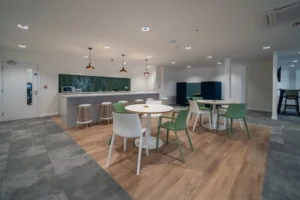
Employees don’t come to the office in 2026 to do tasks they could do at home. They come for connections, creative collisions, and the spontaneous conversations that a screen cannot replicate. Third spaces — informal lounge zones, café-style clusters, standing nooks, and quiet alcoves — are the fastest-growing category in commercial furniture.
These zones sit between the workstation and the meeting room: flexible enough for an impromptu brainstorm, comfortable enough for an extended conversation. Bistro tables, bar-height surfaces, and ergonomic lounge seating borrow the warmth of a great café and make it a permanent architectural feature.
Companies investing in these spaces are seeing tangible results: higher voluntary attendance, longer dwell times, and stronger reported connection to colleagues and culture — the metrics that matter when the office must compete with the kitchen table.
Trend 08 - Smart Storage & the Nomad Kit
Mobile, Digital, Stylish – Finally
Hot-desking created a storage problem that offices are only now solving with real intelligence. When nobody has a permanent desk, personal belongings need a home that’s secure, accessible, and as well-designed as everything else in the space.
Storage in 2026 is mobile – pedestals on wheels that follow the employee through the day. It’s digital – cloud workflows mean physical filing has almost vanished. And it’s smart – keyless lockers integrated with building management systems, bookable via an app, and designed to be an intentional element of the office rather than a utility afterthought.
The “nomad kit” captures the spirit of the moment: a personal storage unit containing everything an employee needs, wheeled to whichever space they’re working in that day. Storage furniture, at long last, doesn’t have to be ugly – and it doesn’t have to be fixed to a wall.
Eight Trends. One Direction.
Taken together, these trends point to a fundamental reframing of what commercial furniture is for. It’s no longer about providing a surface to work on and a seat to work from. In 2026, furniture is a tool for attracting people back to a shared space — supporting physical health, reducing sensory overload, expressing values, and enabling human connection that remote work cannot replicate.
For procurement teams, specifiers, and business leaders, the conversation about furniture needs to start at the beginning of the design process – not as a cost line to be minimised at the end. The offices that get this right will be measurably better at keeping people engaged, healthy, and connected.
And in an era when the office must earn every commute, that is the most powerful business case of all.
- The strategic shift – “Furniture has become a genuine engine of culture and productivity — not a procurement afterthought.”
- The human case – “The best workspaces in 2026 are designed to evolve, support human needs, and help teams work smarter.”
- The bottom line – “Offices must earn the commute. Great furniture is the most compelling argument they have.”
Enquire Now
Ready to transform your workspace? We'd love to hear about your project. Whether you have a clear brief or simply an idea of what you're looking for, our team is here to guide you from that first conversation all the way through to a finished space you'll be proud of. Get in touch today - let's create something special together.